In class I had a long small canvas I wanted to play on. I just wanted to play in color. I like to try different kinds of techniques and approaches to painting, and oil is one of the most versatile mediums for experimentation. You can get thin washes, then thick rich impastos, careful blends and then rich sumptuous glazes. This piece has all of those things. It was a class exercise that I enjoyed immensely. My starting point was a photo I took of a boat that had many layers of paint stripped partially off. It was an inspirational source that will continue to inspire a variety of interpretations for years to come
Sunday, February 5, 2012
An Inspirational Abstract Source for Years to Come
In class I had a long small canvas I wanted to play on. I just wanted to play in color. I like to try different kinds of techniques and approaches to painting, and oil is one of the most versatile mediums for experimentation. You can get thin washes, then thick rich impastos, careful blends and then rich sumptuous glazes. This piece has all of those things. It was a class exercise that I enjoyed immensely. My starting point was a photo I took of a boat that had many layers of paint stripped partially off. It was an inspirational source that will continue to inspire a variety of interpretations for years to come
Tuesday, January 24, 2012
Class Schedule for March -April!

Luminous Watercolors !
Watercolors Classes designed to help you achieve fresh
exciting paintings you will be proud to show!
Gordon Meggison has designed several "immediate reward" exercises that affirm key painting techniques to assure your approach is strong and successful. He encourages "play" as an essential part of learning often set aside for the "serious work" of adulthood. This "Fountain of Youth" ingredient helps you discover the pleasure, sense of poetry and accomplishment that is watercolor. Gordon will help you become "fluid" and loose, one of the features that watercolors is specially designed to meet. Join me and lets have fun!
Gordon's watercolor class schedules are currently as follows:
Reddi Arts: Fridays 10 am -1pm Starting Mar 2- ending April 6
Cost $195.
http://www.reddiarts.com/ClassesandWorkshops.html
www.reddiarts.com or call Jim (904)398-3161 ext 319
JCA: Mondays 10 am - 12pm Starting Mar 5-ending April 9
or: Wednesdays 7pm - 9pm Starting Mar 7-ending April 11
Cost: JCA members: $102. , $153 for non members
www.jcajax.org, or call Thelma Neid at (904)730-2100 ext 227 thelma.nied@jcajax.org
The Cultural Center at Ponte Vedra Beach : Please Request- Upon sufficient request by students, five members is the minimum requirement. www.ccpvb.org or email lrodante@ccpvb.org
Also- Refreshingly Simple Oil Painting!
Oil Painting can be easy or difficult. If you want to avoid tired overworked
oil paintings, Gordon Meggison has simple techniques that get you there fast!
We all want to paint like a pro, but first the basics need to get established or you find yourself making the same mistakes over and over and working yourself to death with little satisfaction. His approach to oil painting covers your introduction from the drawing, sketch wash, and leads you quickly to a pleasing finish in just a few calculated steps. Gordon will help you spot solutions so you can get on with doing what you really want to do, make great paintings!
Classes for Oils at JCA : (www.jcajax.org)
Mondays 7pm - 9pm Starting Mar 5 - ending April 9
Wednesdays 10 am - 12 pm Starting Mar 7-ending April 11
Cost: JCA members $102., $153 for non members
or call Thelma Neid at (904)730-2100 ext 227 or email - thelma.nied@jcajax.org
For materials lists go to host site or www.gordonmeggison.blogspot.com
Tuesday, January 17, 2012
Painting Atmospheric Effects in Oils

Sometimes a painting is not about a particular thing , rather it is about the space around the apparent subject. In this case the subject is not the farmhouse, but about the Tuscan landscape. Here in a couple of hours I rendered a small painting of the Tuscan atmosphere as the hills recede into the distance. Flattening out the treatment of the distant hills makes any detail in the foreground look more close and intimate, but there really is very little detail in this picture. Using warm yellow ochre and some orange and reds muted back in almost everything, even the greens, "warms" the tonal range of the picture to capture that warm summer in the Italian countryside as a day is setting. I could take this basic picture now and warm it and soften it further by adding glazes, but it needs to dry a bit before that can happen. That would be done with oily glaze mixes using burnt sienna. An artist that I love is George Inness if you want to study more atmospheric qualities of light in the way he handled his
landscape subject.
Wednesday, December 21, 2011
Winter Watercolor and Oil Schedule
I am teaching at a couple of locations, Reddi-Arts(reddiarts.com) and JCA (Jewish Community Alliance www.jcajax.org)
These classes are for beginner to intermediate watercolor enthusiasts. Basic color theory, color harmony, composition, wash techniques basic painting skills will be taught
Reddi Arts Watercolor Classes Jan 13,2012 Every Friday 10 am- 1 pm, a 6 week course
JCA Watercolor Classes Jan 9, 2012 Every Monday classes 10 am -12pm, a 6 week course
This class is for beginner to intermediate Oil painting enthusiasts. Basic color theory, color harmony, composition, wash techniques basic painting skills will be taught

JCA Oil Painting Classes Jan 9, 2012 a 6 week course starting at 7pm - 9pm a 6 week course
Saturday, November 5, 2011
Thursday, July 14, 2011
Build up Varnish and Pigment
Here is the latest driftwood addition to the family of new techniques I am exploring. I am moving this out of the studio today like a newborn child ushered off to adoption before I can fall in love with it :( I really love this piece, but it is for ie-designs, so its sold already. In this one I discovered a new technique where I put varnish down thickly and loosely then drop in loose wet paint directly into the varnish to let it ooze naturally together. Then I add other successive colors next to those and let them chaotically run together (controlled chaos) to simulate natural grain and weathering. The varnish becomes a carrier and allows the pigment to fall naturally to different levels, allowing light to pick up color and texture on many levels. Its hard to describe in words or to photograph.
Sunday, July 3, 2011
Imbedded color technique

I am working on a large set of acrylic paintings, a driftwood series for an interior designer Veronique at wwww.IE-Designs.com (from a reference photo I took from a Jekyll Island trip I took). In this particular set I was given a limited earth tone palette, and all color variations had to spring from it, making it somewhat monochromatic. Here are some pictures of the stages of the piece. First I charcoal on the drawing. I could have stopped there , I loved the way the drawing looked! Second I started laying in a ground base of the colors that I premixed and selected, and put into squeeze bottles. Laying these colors down was particularly challenging and confusing. The idea is to put joint compound over this after the color dries thoroughly, skimming on the tree areas, and texturing the other areas. This will be the second base on which Stage 3 will be to sand down and remove the joint compound glaze gently to expose the underground color I laid in in Stage 2. As this color is exposed gradually it takes on a life of its own. I will then in Stage 4 lay in glazes onto the new "white" joint compound to bring back in the appropriate shadows and highlights. (See the pic examples)


Friday, July 1, 2011
Using Masking Fluid For Flexibility
I wanted to introduce the class to masking fluid, to show the class how the use of it can allow the artist to free up the background for wet rich wash techniques without worrying about losing your "whites" ie: the light colors areas. I also added a liberal use of salt to add detail; to the background. Laying in the background can be intimidating, when you worry about losing the wet edge or destroying whites. Here is my new second version of the carp scene using the masking fluid, in varying stages. Stage one you put the masking fluid on the whole carp and ripple bubbles. Stage 2 The masking fluid is rubbed off. Stage 3 more masking fluid is applied within the fish for highlights or "whites" then the fish is toned freely with washes. Stage 4 Is final toning and details.
Lastly to make the fish look underwater, I lightly glaze over the fish with a thin wash of cobalt blue and viridian to "push" the fish down under the waterline leaving a bit of the original color in a few choice areas to make the fish appear to be bobbing up to the surface to eat or the fins rising as they do during their movements


Lastly to make the fish look underwater, I lightly glaze over the fish with a thin wash of cobalt blue and viridian to "push" the fish down under the waterline leaving a bit of the original color in a few choice areas to make the fish appear to be bobbing up to the surface to eat or the fins rising as they do during their movements


Sunday, June 26, 2011
A Chance to Use Rich Color
I chose the carp design because it is an ancient symbol of good luck. I see it as a great chance to use color richly and wetly. I believe it is so because its hard to screw up a painting of these beautiful sensual creatures moving harmoniously together in water. The fish beckon to freely capture their color in loose wet colorful washes running together. This is the chance to discover the joy of watercolor! Here is the carp demo I did, but I believe some of the students actually succeeded at achieving the washes better than I in this circumstance. An example of the pupil exceeding the teacher!


Creating A Landscape Using Simple Values
Saturday, June 11, 2011
Now and Zen, and a watercolor to boat experience!
I was invited onto the Now and Zen, a local Jacksonville charter catamaran sailboat, that is a joy to cruise on. Naturally I jumped at the invitation. To make things even better, the cruise that day was initiated by the Arbus magazine, because they wanted to do an article on the boat, and use a watercolor by me in the article for next months edition. This is why I don't have a "real job"! I am including an "in process" view of the watercolor and a final as it was accepted.
Subscribe to:
Posts (Atom)
Todays Wednesday Custom Art Lessons
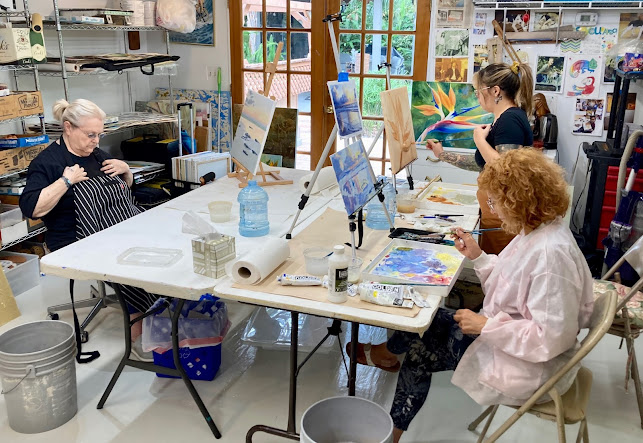
Here are some students engaged each on their own paintings, I help each one at their unique level. Each of my students are amazing creative...
-
I wanted to introduce the class to masking fluid, to show the class how the use of it can allow the artist to free up the background for wet...
-
Here are some students engaged each on their own paintings, I help each one at their unique level. Each of my students are amazing creative...