Tuesday, January 25, 2011

Watercolor: If at First You Don't Succeed Try Try Again


These two watercolors ( Heckscher Marsh 1 (at bottom) & 2 (at top) ) show the beginning of a process of improvement I am working on to bring more looseness to my work. I used a two inch brush for the first one and felt that it was just a bit too out of control so I went back to a 1 " nylon to "chisel" large blocks of wet washes into the painting. I feel the second one gave me a better result.
Every serious artist and anyone attempting to improve their art work should set clear goals for each painting that they are about to do. In watercolors this seems particularly important, because the fast nature of the medium and the immediacy mean that a painting can quickly get away from you. I try to verbalize the features I want to see in my painting before I start out, such as: good composition, purity or boldness of color, luminosity, chiseled strokes, strong compliments clearly defined against each other, use of glazes or resists etc . Stating the qualities that I would like to see the piece have that previous pieces didn't have, helps to maintain a clear target for consistency sake. Then even if I miss all the features, I know exactly what I have missed and I can try again, and again if necessary till I get it right. When I was in Japan, I studied Japanese philosophy as it pertains to art. The subject itself is what westerners tend to focus on at first. From the outset, the oriental looks at the painting as a chance to refine one's discipline and sense of mastery and control of the medium and ones impulses. The painting becomes sublimated to that end. So if you need to paint a subject many times to "get it right" so be it. They sometimes paint the same character, or theme hundreds of times, but by then obviously they will master it. Inevitably you must come to face yourself in that process. You will realize that if you keep doing a thing the same way again and again, you can expect the same results. Suddenly you will have an epiphany and breakthrough to the other side, when you tire of your neurotic rituals and habits, and that will eventually give you the results you desire. Remember:
No masterpiece was ever painted by a lazy artist-Salvador Dali

Friday, January 21, 2011

Watercolor Lesson: Basic Principles of Landscape2


Again I took todays students from the sphere exercise ( as seen on a previous post in November) and moved to the basic landscape exercise. It is designed to show how the principles of light falling on a simple object like a sphere translate to something more complex like a landscape. The difference of course is composition and arrangement, so I had to touch on Composition and the Rule of Thirds. The sketch I show here is my version of a made up landscape, but each student did a version of their own which we will paint later. I did this painting demo at Reddi Arts, rapidly within 45 minutes or less, but consider just a sketch, to get what I would ideally want in terms of perfect highlights and color control, I would need to work more carefully and slowly. I was running out of time and had to race through the demo at breakneck speed!

Thursday, January 20, 2011

Watercolor Demo - A New Direction


I have been trying to break out of my detailed way of working into a broader bolder look. In class Tuesday I decided to handicap myself a bit by using a fatter brush than i am used to using. I started out with a concept, - bold bright flat color not much detail. That was my assignment to myself. You should have a clear goal in mind when you set out to paint. If you fail to plan, you inevitably plan to fail.
It occurred to me that I would need to get out of my comfort zone in order to see a significant change in my work. It takes bravery to get out of your comfort zone, because that implies risk! We are all naturally risk averse to some degree. We want to be successful all of the time. Sometimes, however, success can only be born out of risk and perhaps failure. I consider this painting a success because I tried and learned something new. I like the way the colors are flatter and bolder as I wanted, but I lost something of the emotional power I was looking for in the composition. It is too centered when I intended for the sky to only take up a third of the painting. I got so caught up in the sky that I lost track of the composition. I will try try again, but now I am confident I can achieve my goals, but only because I tried something new. Take a chance and don't be afraid to fail, its only paper and a bit of time. What you can learn from any experience of this sort will surely pay you back tenfold.

Sunday, January 16, 2011

Painting from photographs-The Pros and Cons


People often ask me if they can work from photographs in class. I feel that it is the kind of thing that generates a lot of discussion for and against. There are pros and cons to this subject. Lets consider. If you like to work in a very representational way , photographs obviously can be of great assistance. In painting or photography compositional guidelines still apply. The rule of thirds for instance, is a rule covered in my classes, that helps the viewer understand where the artist is directing a viewer to look. More on that later, so the point is a badly composed picture can lead to badly composed paintings.
When you do your own photography you can play with composition and rearrange objects till you get what you want. Many people try to work from magazine photos, and for amateur explorations, that can be ok, but not for any professional aspirations. Copyright infringements can complicate your life at that point. You need to practice your own compositions anyway for your own sake. Digital cameras are so easy to use and so much better and cheaper to use than the old print film cameras.
Working from life is best, but isn't always practical for either your skill level, or the place or light conditions available. Setting up a still life is something I cover in class, using lights and a tabletop arrangement of your choice, flowers fruit, plates cups etc. I will do a painting from one of these photos I am showing here today, working from the photo to show you how that goes. The disadvantage can be that there can be a lack of spontaneity and a rigidity that can creep in to the work. An over attention to detail can ruin a piece. The pressure of doing something "under the gun" as it were in a brief span of time, figure or still life, can make you work more quickly and fluidly and grasp the "essence" of the subject. That is really what makes the picture interesting, not the tedious details. It takes some practice, much like working out, can be painful at first! Either way stay loose and adventurous. Be Bold, paint with passion!

Wednesday, January 12, 2011

A Bit of Humor: Father Guido Sarducci on art school

My Oil Students Succeed!


My recent oil painting students, relative beginners, turned out to be great listeners and very quickly the techniques. First we loosened up with a paper sketch to get a feel for composition. Then we employed my favorite starting method of laying in a preliminary tonal wash on the canvas board, then doing the drawing direct onto the canvas using the tick mark method, then "connecting the dots" so to speak. Then by uUsing a little thinner on the brush to carve out highlights, and a thin rich mixture of oil and pigment to create shadows and definition, the painting quickly took shape. Bravo Vinod, and Abhijit! The hard part is over now to add color! That's next week.

Thursday, January 6, 2011

On the "Art of Seeing"


Giorgio Morandi (1889-1964) once said,"You can travel the world and see nothing. To achieve understanding, it is necessary not to see many things but to look hard at what you do see." I like this idea, and believe it is the essence of art.

Wednesday, January 5, 2011

Oil Painting Classes at JCA


Well it is confirmed today that I have enough students for the Jewish Community Alliance Oil Painting Classes starting Jan 10 at 7 pm. I am looking forward to the classes, and hope anyone who still wants to be a part of those classes join up soon so that you can get prepared. We will start with simple still lifes, which are manageable in the short time frame we have.

Friday, December 17, 2010

An oil painting from Capri at Marina Piccola


I loved Capri, wished I had stayed longer now. The little island has everything one needs to be happy, culture, cafes, mountains ocean, art. Here is an Oil I did of a little cove at Marina Piccola, much smaller than Marina Grande on the other side, which is what most people see first on arrival to the Isle of Capri. Marina Piccola is small, quiet, crystal clear water, boats great for painting, or renting! You could spend a whole lifetime dreaming just there. A small cat wandering around there reminded me that some creatures do just that!

One of My Students Watercolor Abstracts


I wanted to show these small watercolors by one of my students, Jody Holt, she shows a lot of promise and has come a long way from her early timid ways, to these fresh bold color studies. Bravo Jody! Keep painting

Oil Painting Class Materials

The range of quality pigments and brushes can be mind boggling and is all over the place, so I have narrowed this down a bit for you. I have been working all morning till my eyes have gone blurry on what to suggest for the JCA Oil painting class. I will assume that if you have painted before you already have a set of oils. Newcomers to oils may not even know if they will be committed to this enough to continue so naturally you don't want to spend a fortune to test the waters. So here is my basic suggestion for newcomers: go to DickBlick.com for a simple set of
#9152 White Taklon, Set of 5
">5 brushes I have picked them out for you. Then got to Dick Blick.com to get an
Introductory Set of 10 Colors
">introductory oil set border="0"/> for $55. Another choice and cheaper is a complete set
Daler-Rowney Graduate Oil Easel Set
">Daler-Rowney Graduate Oil Easel Set for $35. Also at Dick Blick , my favorite is a Deluxe Oil Painting Set">Gamblin Deluxe Oil Painting Kit with easel, it has everything for $149.99.

If you are shopping locally: Set of white nylons brushes -Flats #12,#4, #2, and rounds Filbert#4,#2, a Whale tale palette knife, Gamblin refined linseed oil, stand oil, Gamblin Gamsol pure odorless mineral spirits, four 8X8" Ray mar Boards to paint on or some canvas boards will do, disposable, a Strathmore paper palette tablet, and a small oil tub and brush cleaning bottle with a coil in it, for thinner, paper towels or rags.

Todays Wednesday Custom Art Lessons

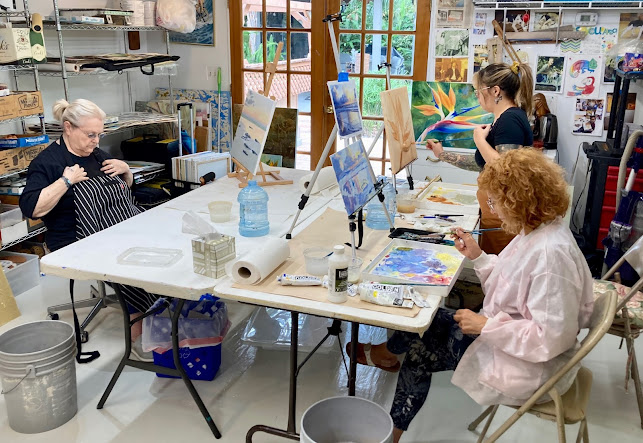
 Here are some students engaged each on their own paintings, I help each one at their unique level. Each of my students are amazing creative...